I have assumed that most people have cable or satellite television and are not picking up their programming from the free electromagnetic television waves darting through the air. I assume this because of the reactions I get whenever I mention I don't have cable. You would think I just said I need to go turn the crank on my car.
Well anyway, we got this under-the-cabinet radio/tv device for the kitchen for Christmas. Having no cable, I need to hook it up to an antenna. I want to use the rabbit ears on the tv in the den and get a new antenna for that tv. Although it has been a few years since I bought an antenna I remember buying one at RadioShack. So I went to RadioShack and asked if they sell them. They do. And they aren't hidden in the back in dusty boxes behind the eight-tracks. They are right there on the shelf. And in fact, the model I wanted, which has a picture frame incorporated into it, was sold out...but will be sent with the new shipments on Thursday. So they actually restock these too.
So there are obviously others out there who still use tv antennas.
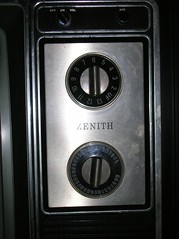
A colleague of mine was telling me about his home entertainment set up and I mentioned I don't have cable (gasp!) and that the tv in my living room is actually an old dial tv I bought used from some guy when I was single and living alone (but I should state we do have a more modern tv in the den that we use the most). He didn't believe me so I needed to send him a picture of it, which is the photo here.
Showing posts with label technology. Show all posts
Showing posts with label technology. Show all posts
Tuesday, January 02, 2007

Tuesday, December 12, 2006
Finding iPods in California
About a month ago, I was in Santa Monica for some client work. I was still on East Coast time so went for an early run along the beach. There really are a lot of homeless people in Santa Monica, and apparently if you are out early, it is just you and the homeless. One man I saw, I swear had an iPod. He was obviously homeless, with all the indications of homelessness, but there hanging down from his ears dangled the white headphone cords of the iPod. I thought, "only in California would the homeless have iPods."
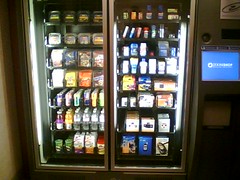
Water on the left, iPods on the bottom right.
Right now I am at the Sunnyvale Sheraton. I forgot my toothpaste, so went down to the lobby and I as I walked I saw a vending machine with some toiletries, as well as the normal vending machine items, like chips, snacks, and beverages. It didn't have any toothpaste, but it did have iPods. And iPod accessories. It is a vending machine with iPods. So I can buy my peanut M&Ms, a bottled water, and a iPod shuffle all in one. From the vending machine.
Only in California.
P.S. The Blogger spell check wanted to replace "iPods" with "aphids."
Water on the left, iPods on the bottom right.
Right now I am at the Sunnyvale Sheraton. I forgot my toothpaste, so went down to the lobby and I as I walked I saw a vending machine with some toiletries, as well as the normal vending machine items, like chips, snacks, and beverages. It didn't have any toothpaste, but it did have iPods. And iPod accessories. It is a vending machine with iPods. So I can buy my peanut M&Ms, a bottled water, and a iPod shuffle all in one. From the vending machine.
Only in California.
P.S. The Blogger spell check wanted to replace "iPods" with "aphids."
Thursday, June 08, 2006
The best tools solve many more problems than their inventors intended
....is the title of this slide on a presentation on RSS and Atom.
That is a really good statement. The author includes mostly technical "tools," like XML and the Internet, but throws duct tape in too. I'd add WD-40 and screwdrivers.
That is a really good statement. The author includes mostly technical "tools," like XML and the Internet, but throws duct tape in too. I'd add WD-40 and screwdrivers.
Monday, May 22, 2006
Writing letters, part 2
While looking for some other info this morning, I came across this article from EContent that opens with:
which reminded me of my post (ironically published just a week before this EContent article) on writing letters inspired from reading an article in Newsweek about writing letters and an experience my wife and I had about...writing letters.Parents: Ask your teenager to write a "get well" letter to Aunt Edith who is confined to a bed at a nursing home. They are probably looking at you like you just asked them to explain Kepler's Third Law. "C'mon mom, nobody writes letters anymore," they whine. "They're not cool."
While it may be a question of changing social mores, more than likely it is the way today's young people were raised in relation to technology. "The next generation was born digital," according R.J. Pittman, CEO, president, director, and co-founder of Groxis, Inc., who gave the opening keynote at the 2006 annual NFAIS Conference in Philadelphia. The "next generation," he describes, was raised communicating through cell phone, either voice or text messaging. The audacity you have to suggest they (gasp!) actually pick up a pen to communicate is nothing short of alarming. It simply isn't as natural for them to put their thoughts down on paper in a clearly written missive, get an envelope, address it, stamp it, and trudge out to a mail box than it is to (duh!) dash off a text message and hit Send. Better immediate information than perfectly penned, right?
Wednesday, April 19, 2006
Kids and technology
I am on a business trip in Alexandria, VA and read some of the USA Today someone kindly left outside my hotel room door this morning. I came across an article titled Life's connections aren't all plugged in by Bruce Kluger.
He gives an account of his daughter who corresponds with a pen-pal in Australia in actual written letters, not e-mails or IM. He goes on to say:
Kruger believes kids can switch back and forth from the online/connected/PC world to the real human world more easily than we think
He gives an account of his daughter who corresponds with a pen-pal in Australia in actual written letters, not e-mails or IM. He goes on to say:
Among the many challenges facing parents today is the way in which we can help our kids reconcile new technology and old values. This isn't exactly easy for me, as I'm not one of those dads who distrust the electronic revolution.I had my own internal debate on when to expose my own kids to computers. I didn't want the computer to be another screen for them to look at. I read some articles on the topic and one example that hit home with me is that a child learns more about shapes by touching and feeling a ball or a cube than by looking at them on a computer. We have a PC for the kids in the house now but I never felt rushed to get it for them. And I never felt they would be behind for not having one before the oldest was 6.
Kruger believes kids can switch back and forth from the online/connected/PC world to the real human world more easily than we think
And yet what I'm beginning to recognize is that kids will unplug from the wall and plug into the real world more readily than they'd like us to believe. Like adults, they are hard-wired to make the kinds of connections that don't require a modem, but the trick is in exposing them to both the crackle of technology and the warmth of human interaction, then letting them see the difference for themselves.I hope he is right.
Friday, April 14, 2006
Writing letters
Although I read Newsweek to help me stay on top of current events, one of my favorite sections is the My Turn column, in which average people write some short article. The topics range from serious to not so serious, but they are generally good and sometimes insightful.
In the April 17, 2006 issue, William Shaw, in his article titled We Had the Love, But I Long for the Letters, remorses that he and his wife never wrote letters to each other. She is gone now and he has photos, but
I am thankful I don't need to write out on paper, but I do agree with William's general sentiment. Think of it this way: pulling out an old typewritten letter doesn't have the same "feel" as one in the person's handwriting.
Most of the letters that I did write were in college. I'd be curious what college kids do today. Text message and IM I guess. You can't reminisce with that.
In the April 17, 2006 issue, William Shaw, in his article titled We Had the Love, But I Long for the Letters, remorses that he and his wife never wrote letters to each other. She is gone now and he has photos, but
The memories that pictures and souvenirs produce are marvelous, and I wouldn't part with them, but what I don't have, in black or blue on white, are her thoughts.He makes an interesting connection to our modern technologies.
What I'm trying to say is that our lives have changed. That special something in a personal letter has disappeared with the advent of telephones, airplanes and now e-mail—which is impersonal and limited by the lack of what I shall call "personal ambience."Recently, my wife and I wanted to write a letter to a physician who we felt provided us a great level of care during complications my wife had in our daughter Molly's birth. Although I work in a technology related field, my wife does not. She barely uses a computer. I went to pull out the laptop to compose this letter, and my wife looked at me puzzlingly. She couldn't put her thoughts down on a computer. She needed to take a pen in her hand and write it out on paper. I am just the opposite. Between my poor handwriting and the rarity of needing to write more than a few notes, I am almost physically incapable of writing a letter with pen and paper. The last time I did must have been 10 years ago. Now, I compose everything in front of a PC.
I am thankful I don't need to write out on paper, but I do agree with William's general sentiment. Think of it this way: pulling out an old typewritten letter doesn't have the same "feel" as one in the person's handwriting.
Most of the letters that I did write were in college. I'd be curious what college kids do today. Text message and IM I guess. You can't reminisce with that.
Friday, March 31, 2006
Good content trapped in old technology
Through the Web Ink Now blog, which I check on only occasionally, I found this post questioning whether advances in technology are a threat to great content wrapped up in older formats. The author, Andy Monfried, uses an example of a bootleg concert on DVD and asks ,
On a related note, a former colleague of mine, defending the practice of copying MP3 files from Kazaa and other file-sharing sites a few years ago, made a good point about the number of times he bought the same song. He owned it on a record, then on cassette, and then bought it again on CD. He paid three times for the same content, just in different formats. Are we buying the content or the format?
Does Technology own the content of the future?Now, I'll skip over the issue that these are bootlegs, because I do think this is an interesting question. But it is not a new one. How many cassette tapes do you have cluttering some drawer, never to be listened to again? You may have purchased (or "stole") that music again on CD or computer file (MP3, etc) but my bet would be that you didn't replace all of it. I went through some of my parents' old books and although I read a few, some of them were too musty to bother with. The format, or the technology, can certainly be a limitation for the content it carries.
Will future generations ONLY EVER get a chance to see, and witness things recorded in "High Definition" or HD quality - or some other futuristic format?
Will incredible content, NEVER GET SEEN, because it was recorded BEFORE TECHNOLOGY advances?
With IPODS....Home Theaters....and, new gadgets coming out, will anyone want to hear my AUDIENCE COPIES of bootlegs from the Grateful Dead? (Meaning, someone who recorded a DEAD show, with a microphone and was NOT plugged into the soundboard...)
Will, technology render them useless, and nothing more than garbage, to future generations, even though the content is TOPS?
Will old content NEVER GET A CHANCE, to become someone in the future's, favorite musical choice?
On a related note, a former colleague of mine, defending the practice of copying MP3 files from Kazaa and other file-sharing sites a few years ago, made a good point about the number of times he bought the same song. He owned it on a record, then on cassette, and then bought it again on CD. He paid three times for the same content, just in different formats. Are we buying the content or the format?
Friday, March 10, 2006
Crappy technology
I was listening to a Slate Magazine podcast in my commute to work today (you know, because I am so hip) on auto-flushing toilets. That's right, toilets. There are examples of the poor, overuse of technology everywhere. Even in the bathroom. The podcast/article starts:
My office shares a men's room with everyone who works on our level. The bathroom sports three stalls, each of which is outfitted with the most uncivilized technology of the modern age—the hands-free, automatic-flush toilet bowl.High-tech auto-flushing limits your ability to flush when you need to flush. The author, Nick Schulz, makes the point that the auto-flush toilet is incapable of doing three very important things: flush the toilet before you sit down, flush the toilet while you are seated, and give the ole' double flush if the first flush didn't do the job. After analyzing the pitfalls of the auto-flush, Schulz brings us back to what really works: a manual flush:
As it happens, there is an almost perfect technology already in existence: the foot-pedal flush toilet.Here is the article on the web: The Crappiest Invention of All Time.
Friday, February 24, 2006
Welcoming big brother
So for the first time in several years, I was in a meeting that included a video-conference with another group half way across the world. It was really good quality, both in sound and video. Our host at the meeting had a nice and inexpensive set up. He told us how his entire office has moved into not just video-conferencing (a necessity for his business) but also nearly permanent remote video discussion with cameras that clip to laptops and other devices. Almost every remote conversation they have now is audio plus video, even if the other person is just down the hall. This led to some jokes about working from home and seeing each other - and sometimes spouses - in pajamas. But still, I nudged my boss that we need this at our company.
Before this meeting, I've been reading alot about the social web, Web 2.0, and all the other terms people use for the evolutions we are seeing in technology and people's personal interaction with it. And of course, I like to test things out and see for myself. When I posted photos to Flickr, I really thought for awhile about whether I really wanted to make pictures of my kids public. I don't imagine any harm would really come from it, but for now decided not too. But I've set up some family and friends to view them.
But so many people post their personal pictures. So many people blog about personal matters. A colleague at a client company went through marathon training and posted pictures of her swollen and bruised feet on her blog (which, besides the feet, provides interesting insights into her training for such a monumental event). But this would not have happened just 1 year ago. (Note the link above goes to her blog, not a picture of her feet. I've spared you that.)
Now, I have nothing against this openness. I think it is all widely fascinating. And I love the community spirit that these technologies help to foster. And of course I am writing this blog (but who knows if anyone is reading....). I just said I use Flickr. I've tested del.icio.us. . I've made the blogs I read public to the world. It's all good.
But I also find it interesting, how in some way, we have created and accepted some version of big brother. Ok, maybe it is not big brother when you voluntarily open up the view into your life. No one is forced to post pictures of their chilren or blog about their innermost feelings. But in any case, the tools exist for those who want to allow big brother to see and broadcast their world.
P.S. And because I believe that just about everything has already been thought about, I did some Google searches on this topic after I wrote the above.....
Here is an article full of menacing doom.
Before this meeting, I've been reading alot about the social web, Web 2.0, and all the other terms people use for the evolutions we are seeing in technology and people's personal interaction with it. And of course, I like to test things out and see for myself. When I posted photos to Flickr, I really thought for awhile about whether I really wanted to make pictures of my kids public. I don't imagine any harm would really come from it, but for now decided not too. But I've set up some family and friends to view them.
But so many people post their personal pictures. So many people blog about personal matters. A colleague at a client company went through marathon training and posted pictures of her swollen and bruised feet on her blog (which, besides the feet, provides interesting insights into her training for such a monumental event). But this would not have happened just 1 year ago. (Note the link above goes to her blog, not a picture of her feet. I've spared you that.)
Now, I have nothing against this openness. I think it is all widely fascinating. And I love the community spirit that these technologies help to foster. And of course I am writing this blog (but who knows if anyone is reading....). I just said I use Flickr. I've tested del.icio.us. . I've made the blogs I read public to the world. It's all good.
But I also find it interesting, how in some way, we have created and accepted some version of big brother. Ok, maybe it is not big brother when you voluntarily open up the view into your life. No one is forced to post pictures of their chilren or blog about their innermost feelings. But in any case, the tools exist for those who want to allow big brother to see and broadcast their world.
P.S. And because I believe that just about everything has already been thought about, I did some Google searches on this topic after I wrote the above.....
Here is an article full of menacing doom.
Just as Marx seduced a generation of European idealists with his fantasy of self-realization in a communist utopia, so the Web 2.0 cult of creative self-realization has seduced everyone in Silicon Valley.This one mentions some video program you can pay for to be part of big brother.
You've read the book and seen the film. Now you too can oppress the proletariat - and for only £3.50 per week!Ok, its been years since I read 1984, so maybe my depiction of big brother is wrong. This blog posts says all the authors are "mini big brothers" and has some quotes from Orwell's book:
The problem is that the Howard Rheingolds of Silicon Valley have the future back-to-front. The likely dystopia is not the ubiquitous eye of pervasive computing, but rather the way in which technology is making everyone into authors. The future is not to be feared because of the threat to individual self expression, but rather because of the threat of too much self expression. Digital technology is making all of us into mini Big Brothers with our own blogs, podcast and videocast shows. The concern is not the death of individual rights, but rather the demise of an authoritative broadcast media and the rise of what Christine Rosen calls egocasting.
Monday, October 03, 2005
Electric can openers
Word Spy, a site that tracks jargon and buzzwords, offers up this term and definition:
Although I've never heard this term before, the electric can opener is a terrific example of technology overkill . I never liked electric can openers. We don't have one in our home. We have the little manual kind you turn. My cans open just find and I have a little more counter space.
electric-can-opener question n. The recognition that some older, low-tech products are superior to the newer, high-tech products that are supposed to replace them.
Example Citation:
Ultimately, the question for potential Iridium buyers was what has sometimes been called the electric-can-opener question. Why pay a lot of money to buy something which you know to be inferior to an older, cheaper technology?
—Editorial, "The sky's not the limit," The Globe and Mail, August 23, 1999

Tuesday, May 10, 2005
When technology is not the answer
Although I work in technology, I strongly believe that technology is not always the answer. When used properly, technology is powerful and helpful. But sometimes, it can be overapplied, and when technology is used for technology's sake alone, it just isn't helpful.
This is just a general feeling and related to a general belief in approaching like with simplicity. But I'd like to begin to collect real world examples. They can be small or big, but some concrete examples of when technology was not the answer.
Ok, first one I can think of is small. I've seen this in several offices. The "old" way of reserving a meeting room was to put a piece of paper on the door and people would "sign up" for a time. Then many offices moved to scheduling their conference rooms with Outlook. Many people don't even understand how to do that, but really what's not effective about this is that if you want to have an impromptu meeting, you go to the room but never know if it has been reserved or not, or who reserved it. Seems simpler to me to just post the piece of paper on the door.
This is just a general feeling and related to a general belief in approaching like with simplicity. But I'd like to begin to collect real world examples. They can be small or big, but some concrete examples of when technology was not the answer.
Ok, first one I can think of is small. I've seen this in several offices. The "old" way of reserving a meeting room was to put a piece of paper on the door and people would "sign up" for a time. Then many offices moved to scheduling their conference rooms with Outlook. Many people don't even understand how to do that, but really what's not effective about this is that if you want to have an impromptu meeting, you go to the room but never know if it has been reserved or not, or who reserved it. Seems simpler to me to just post the piece of paper on the door.
Subscribe to:
Posts (Atom)